Having two kids back to back has limited my ability to travel to freediving locations. And being well aware that an hour-long boat ride in any direction from Bahrain won’t get you much deeper than 26 meters, even in the best-case scenario, I had more or less accepted that Bahrain’s seas simply weren’t deep enough for serious depth training.
But this happily self-imposed travel restriction forced me to reassess that belief.
Step 1: Discovering Bulthama
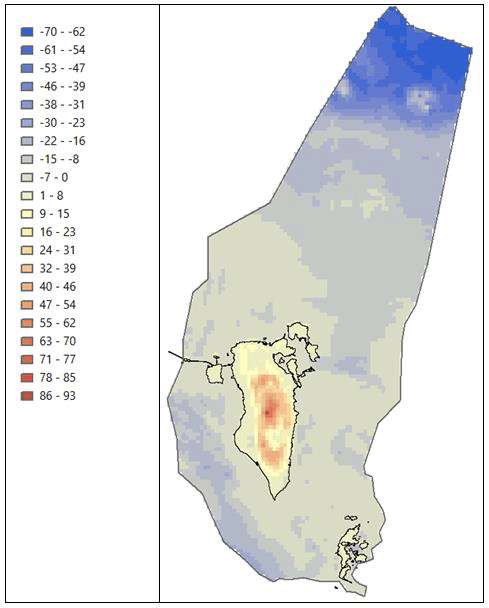
(Bahrain land elevation and sea depth in meters. Source: https://www.researchgate.net/figure/Bahrain-land-elevation-and-sea-depth-in-metres-SRTM30-PLUS-Becker-at-al-2009_fig2_347743598)
It turned out I simply wasn’t looking far enough.
On the northeastern edge of Bahrain’s territorial waters is an area known as Bulthama, where the seabed drops beyond 70 meters.
Granted, that doesn’t meet the depth requirements of many competitive freedivers. But it’s more than enough to maintain a good level of baseline fitness and depth adaptation.
Armed with this new knowledge, I became consumed by the possibility of diving the depths of Bulthama.
The idea that I could access these kinds of depths without getting on a plane, and still come home to my family at the end of the day, seemed too good to be true.
It became an obsession that kept me up at night. My mind wouldn’t rest until I knew whether this was actually feasible.
Step 2: Research
As it turns out, Bulthama is arguably one of the best diving spots in Bahrain, for different reasons and for different kinds of divers.
Scuba divers enjoy its lush underwater landscape and the incredible diversity of marine life it attracts. Spearfishers go there hoping to catch a monster fish that could feed them, and possibly their neighborhood, for the rest of the year.
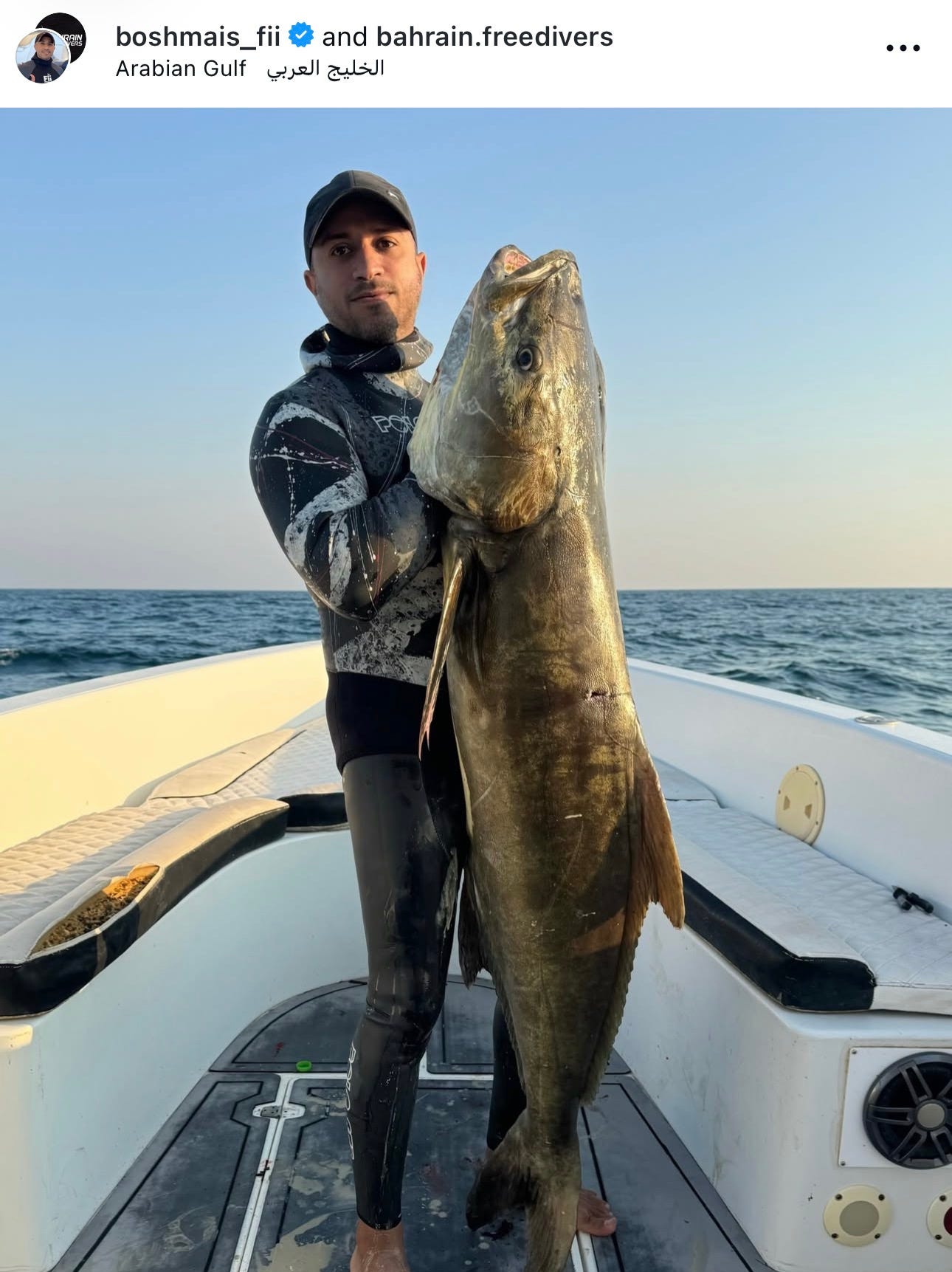
I began interviewing anyone I could find who had experience going there. I told them about my plan to freedive the depths of Bulthama and asked them to poke holes in it.
Unsurprisingly, most people thought it was a pretty stupid and dangerous idea.
To be fair, they weren’t freedivers, so I had to keep that in mind.
There was one story in particular that kept coming up: the tragic death of well-known Bahraini scuba diver and photographer Hasan Janahi, who died while exploring a wreck in Bulthama.
https://www.gdnonline.com/Details/823777/Bahraini-diver-and-photographer-Hasan-Janahi-dies
I’ve since heard some beautiful stories about Hasan.
He was an ambassador of the sea. He made a video documenting the damage caused by prawn trawling on the seabed. It was apparently so impactful that the government banned the practice shortly after the video was released.
He also seems to have acted as something of a guardian of Bulthama. As a natural reserve, there are rules in place to protect it, but enforcement that far offshore can be difficult. Hasan was known for keeping commercial fishermen in check.
I wanted to understand his accident, not out of morbid curiosity, but because I needed to understand what it might tell me about the risks of diving there.
I collected first and second-hand accounts of what happened that day. I can’t know exactly what happened, but the accounts I heard broadly pointed toward the same concern: the dive involved breathing compressed air at depths beyond 40 meters for an extended period.
At those depths, nitrogen narcosis can severely impair judgment and decision-making.
Freedivers face a very different physiological risk profile because we don’t breathe compressed gas at depth. Nitrogen narcosis from breathing compressed air therefore wasn’t one of the risks I needed to design around.
There were, however, plenty of others.
Strong Current
Another issue everyone mentioned was Bulthama’s strong current.
A common way for freedivers to manage current is to drift dive. Instead of anchoring the boat, the boat and divers move together with the current.
This only works if the deep-water area extends far enough in the direction of the drift. If the current carries you quickly into shallower water, the session is over.
That was something I couldn’t properly assess from maps or conversations.
Eventually, I realized there was only one way to find out.
I had to go there myself.
Pirates
A reasonably strong deterrent: Iranian pirates.
Yes, that’s a real thing.
And there had been a number of incidents in the waters around Bulthama.
https://www.policemc.gov.bh/en/news/76543/
Take another look at the map. Bulthama sits right at the edge of Bahrain’s territorial waters. When you’re this far offshore, things start to feel a little like the Wild West. You’re far beyond the areas where help can reach you quickly.
Bulthama also lies out toward the international waters between Bahrain and Iran, which helps explain why this particular risk kept coming up.
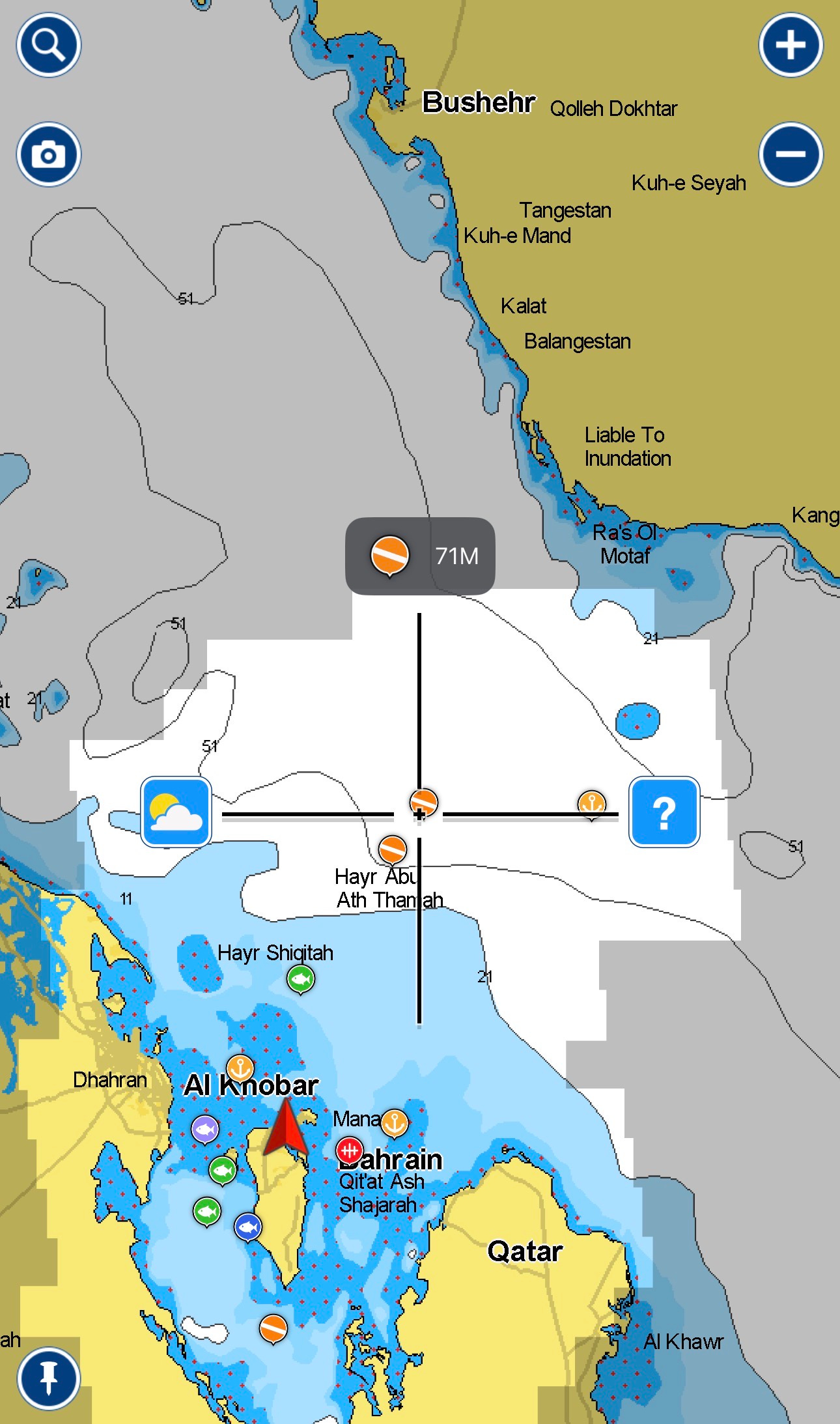
I dove deeper (this time figuratively) into the reported incidents to understand what we might actually be dealing with.
The second-hand accounts I heard weren’t always consistent, so it was difficult to draw firm conclusions about how these outlaws operate. But the stories were serious enough to take into account. I heard accounts of armed pirates stripping boats of equipment and leaving their passengers with little more than the bare hull.
I also heard of an incident in which pirates allegedly opened fire on a private fishing boat as the fisherman tried to escape, apparently attempting to disable his engines. He reportedly made it back safely, although his boat had taken several bullets.
The risk could never be eliminated, but there were ways to reduce our exposure:
Stay wary of nearby vessels, particularly unidentified ones without AIS.
Carry binoculars to identify boats while they’re still far away.
Carry reliable long-range communications equipment for distress calls.
Use a boat with enough range, reliability and power to get us home quickly.
Step 3: Minimizing freediving-related risks
Decompression Sickness
I sought guidance from experienced freedivers to determine whether diving this far offshore was reasonable from a safety perspective.
An ideal deep-diving location would be close to shore, with emergency medical care and a hyperbaric chamber nearby.
Being almost two hours from land rather limits your options.
It turns out that it’s possible to simulate the effects of a decompression chamber by breathing 100% oxygen at varying depths for carefully monitored times. It’s extremely risky, if not done administered properly, since oxygen toxicity is deadly.
Here’s the research paper our emergency protocols are based on: https://docs.google.com/document/d/1Xf9CWHuybaysf1NadjSk0Yn0SbpKO1m3FFXZJNWuo58/edit?tab=t.0
Getting an appropriate oxygen cylinder turned out to be surprisingly difficult. Regular scuba cylinders couldn’t simply be filled with 100% oxygen. Oxygen filling requires compatible equipment, preparation and proper labeling.
I’m grateful to Eyad for helping me sort this one out.
Counter-ballast system
When diving beyond 60 meters, having a counter-ballast system adds an important layer of safety.
In the unlikely event of a deep blackout or another emergency at depth, a safety diver may not be able to physically bring an unconscious diver all the way back to the surface. Manually hauling up the dive line is possible, but it’s slow and exhausting.
I tried to find a counter-ballast system that could work from our boat, without much success.
Then my friend and fellow freediver Ahmed Galadary heard about the problem and decided to build one himself.
What we ended up with was a surprisingly elegant rig.
We’ve never needed to use it in an emergency, and hopefully never will, but having it with us adds another layer of comfort and security.
Here’s footage from our first test, retrieving me from around 20 meters.
You may have noticed us using the boat’s sonar to track divers underwater. A diver can disappear from sight surprisingly quickly, often as early as 10m. The sonar gives the surface team another way to monitor the diver’s position and speed throughout the dive.
It’s not a replacement for safety divers or any of our other safety procedures, but rather an additional layer of awareness that can be useful when diving to over 60 meters.
Step 4: (Not) Making it to Bulthama
Eventually, I was ready to go.
The counter-ballast system wasn’t finished yet, so the plan for the first trip was deliberately conservative: get there, do some shallow dives and understand the environment.
A few friends had already warned me that taking our jet boat all the way to Bulthama probably wasn’t a great idea. Reliability was a concern.
I didn’t really have another option.
And I was getting restless.
The day finally arrived. The dream team was assembled. The conditions couldn’t have been better.
The sea looked like glass.
Our target was about 50 nautical miles away.
After roughly an hour, we reached the halfway point.
And we had half a tank of fuel left.
The arithmetic was difficult to ignore.
If we kept going, it was going to be a one-way trip.
I slowed the boat down as the realization sank in. Naturally, everyone wanted to know what was happening.
Breaking the news was embarrassing, to say the least.
We turned around.
It was now clear that the jet boat wasn’t going to cut it.
Commercial diving companies no longer seemed to operate trips to Bulthama, either. I tried renting boats from several companies, but they all asked the same question:
“Where are you planning to go?”
“Bulthama.”
“…No. That’s not allowed.”
There was only one solution left.
Getting a new boat took about five months.
The experience helped (or, more accurately, forced) me to unlock entirely new levels of patience.
Finally: Diving Deep
January 28, 2026.
We finally made it to Bulthama for our first proper diving session.
The boat journey took just under two hours.
Getting there had taken more than a year.
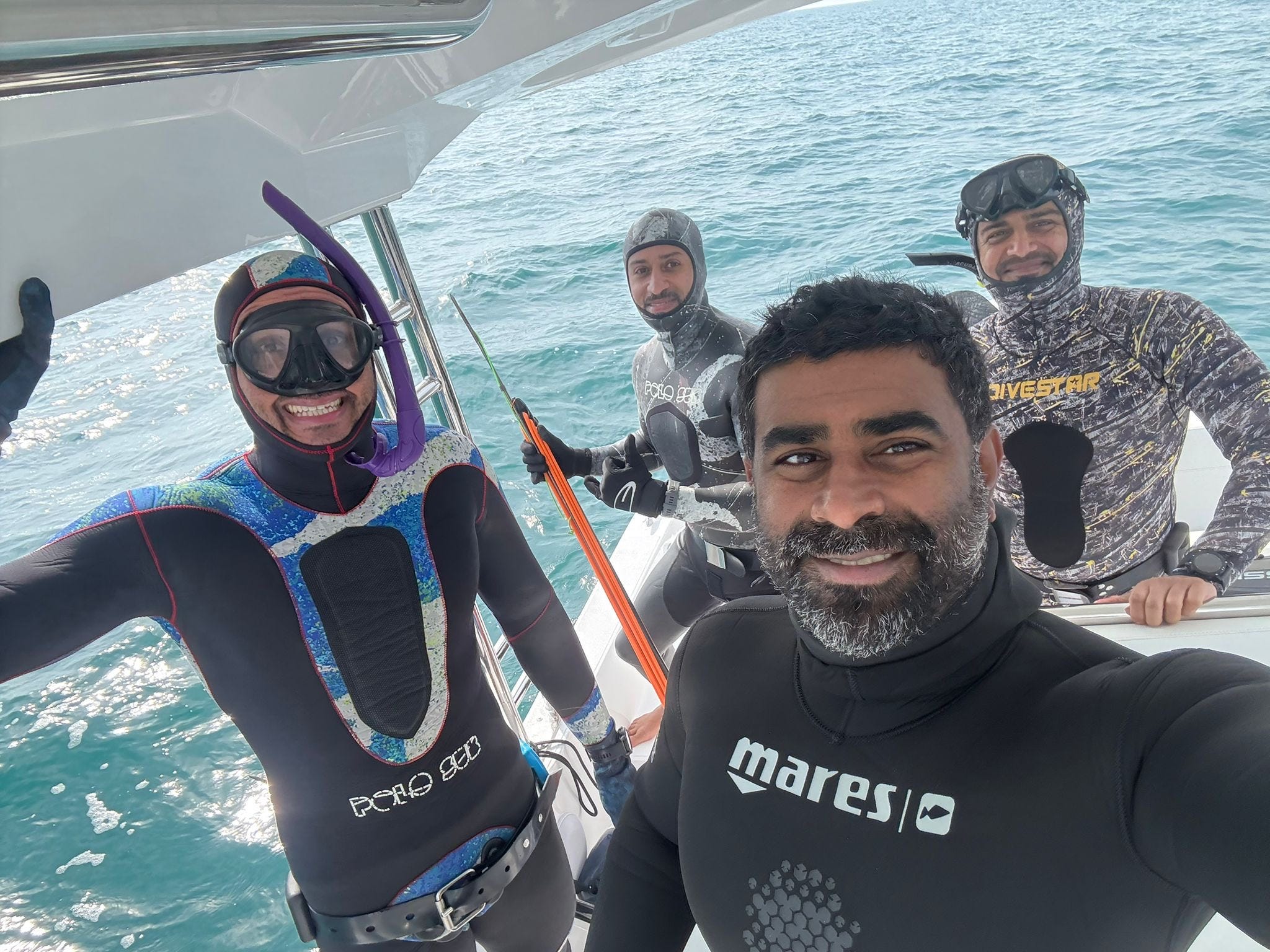
A dream came true.
I don’t think I fully appreciate how much this had consumed me until I was finally there, diving on the line with 70 meters of water beneath us. That first session was one of the most memorable days of my life. There was a childlike joy to it.
The moment the stays with me most was coming back up from my first deep dive.
As I approached the surface, I could see the boat above me and sunlight getting brighter as my buoyancy increased. I had spent so long wondering whether this whole idea was actually possible, and somewhere during that ascent, the answer began to sink in (pun intended).
This works. We can actually do this.
When I surfaced, I was almost in tears.
Bulthama wasn’t just an interesting spot on a depth chart anymore. It was a place where we could genuinely train.
Even today, after going there nine times, it still feels surreal. I can dive to 70 meters on a Friday morning and be back home with my family before sunset.
The current can be strong, but so far it has always been manageable. We haven’t encountered any pirates, yet, but we are often greeted by sea snakes. On rarer occasions, dolphins or sharks keep us company.
(A blacktip shark filmed by Khalid during one of our depth sessions. He kept us company for almost two hours.)
Granted, the four-hour round trip isn’t always easy.
But I’ve grown to appreciate that part of it too.
Our world is full of constant stimulation. Out there, you’re surrounded by nothing but water as far as the eye can see. There’s no signal. The wind makes long conversations difficult, so most of the time we simply sit quietly and watch the sea go by.
For two hours, there’s nowhere else to be.
Then Bulthama’s depths appear beneath us.
And we patiently wait to be embraced by its depths once more.
None of this would have been possible without the people who helped me along the way. From sharing their knowledge and experience, to helping solve problems, build equipment, joining me on long trips into the middle of nowhere, and entertaining unusual ideas.
And a special thanks to the friends who keep making this journey with me. Freediving may be an individual sport, but none of this happens alone.
Missed you on Substack! As someone who witnessed the Bulthama enthusiasm from its early days, I’m extremely happy for you 💙
I have a suggestion. Posts like this should come with a disclaimer: “If you are my mother, do not read this.” My heart sank to unparalleled levels numerous times while reading this (pun definitely intended). May you always find joy while exploring this magical planet that hosts us, and may your mother’s heart be preserved while you do so :)